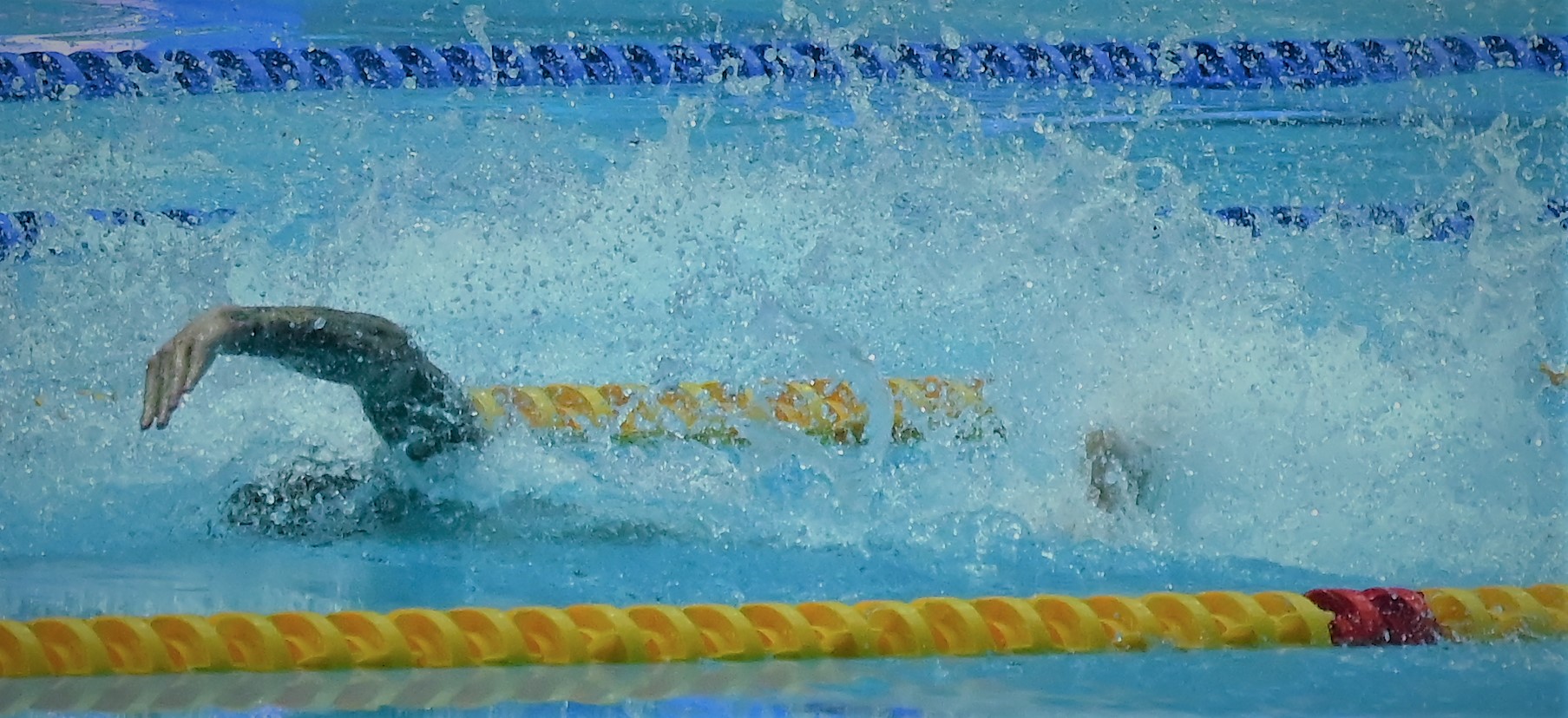

Power to be in awe of – Kaylee McKeown

Kaylee McKeown sets a new World 200m women’s backstroke record in a time of 2:03.14

Every body is writing about this fabulous swim so it is hard to say anything new.

What mywaterworld.life has done is look at some of the stats of Kaylee’s magnificent 200 backstroke and we have included, as a comparison, the former world record holder’s times.

Kaylee’s 200m stats

Meters Under Water
(at Start and Turn)
Strokes
(per 50m)
Lap timeSplit timeDPS* (meters)Regan Smith
(lap time)
Regan Smith
(split time)
143229.3229.321.1329.0629.06
103531.411:00.731.1431.311:00.37
93631.111:31.841.1431.471:31.84
93731.302:03.141.1131.512:03.35
* DPS – Distance Per Stroke

Taking a closer look at this data, Kaylee did a magnificent 2nd 100m – just fabulous pacing. Her 1st 100 was in 60.37 while the 2nd was in 62.41. Kaylee was behind Regan by 0.26 seconds at the 50, and a further 0.10 seconds at the 100 meter mark.

From then on it was all Kaylee who caught up the 0.36 advantage Regan held at the 100m mark on the 3rd 50, and then powered home in a 31.30, outpacing Regan on the last 50 by 0.21 seconds.

mywaterworld.life has located footage of this swim on YouTube that is worth watching.

Controlled pace and an amzingly powerful last 50m by Kaylee – a must watch and a lesson to all.*

The footage on YouTube comes from the BairnOwl channel, while Regan Smith’s times were sourced from a SwimSwam news story from July 26, 1019. mywaterworld.life was poolside in Gwangju when Regan smashed Missy Franklin’s record by 0.71 seconds.

Reaction Times and More on Pacing

How important and significant are reaction times?

Today we take a dive into the outcome of the Mens 4 x 50m freestyle relay at the World Aquatics Short Course Championships.

The margin between the 1st and 2nd placings was only 0.04 seconds – tighter margins are feasible, but not by much. Australia won this relay, not because it swam faster in the water, it didn’t, but because team members had better reaction times, by 0.09 seconds in total, than those of the Italians – and that was enough for the win.

Check out our story on the importance of reaction times and pacing in 400s.

Starts, Turns and Pacing

World Aquatics Championships provide a great opportunity to have a look at the difference in skills, and therefore the effectivness of the execution of race plans.

mywaterworld.life has put together this quick analysis of the Women’s 400 and Men’s 1500m freestyle events and the 4 x 100 freestyle relays.

In none of the events were the diffences in reaction times and skills off the turns significant enough to affect the results in any meaningful ways.

The events featured are all longer events, or relays, but when you get down to the shorter ones (50s and 100s) , and especially as this is short coure racing, hundreths of a second make the diffrence between a podium finish and not even making a final. This equally applies in relays as there are multipel changeovers and corresponding reaction time. It is so important to make evey push-off and turn in training a skill development pririoty. And as for the starts and turns, try some box jumps and burpees.

Pacing for the distance events is critical so have a look at the tables and see how consistent the pacing needs to be – train that pacing.

Kyle Chalmers – 44.84 – 100m Free World Record

How good is it to get first hand insights into what it took to set a new men’s 100 Freestyle World Short Course Record – Congratulations Kyle Chalmers!!!!

Out in 21.40, (0.32 under world record pace) and back in 23.44 for a new world record mark of 44.84 Wow!!

Thanks as well to Brett Hawke for the interview.

Kyle has been on a journey of racing over the past couple of months, maximizing that imense talent, and racing like he has never raced before.  One of the keys to that world record was Kyle’s racing schedule, week in and week out, and the opportunity to implement what he practices in real racing conditions.

I his own words, Kyle has “ finally started to figure it out”.  The constant racing enabled Kyle to work out and implement what he had to do to execute a great swim for that world record and execute he did.

The fruits of the work Kyle has put in can be seen in the break out off his start, the “execution into the walls”, leg speed in the turns, “pumping five fly kicks off the wall”, stroke rate maintenance, and hitting his goal time at the 50m split. 

Yes, the importance of the work off the wall. In the interview Kyle maintains that this is still “an area [he] needs to improve on to be the best in the world”. He also speaks about the role of his coach in pushing the skills aspect ”day-in, day-out”.  Kyle also talks about his breathing pattern – shows how individual that is.

Check out Brett Hawke interviewing Kyle Chalmers about his short course 100m freestyle world record.

Drills – Backstroke – comprehensive and complete

This very comprehensive video is produced by SWIM FAST and features elite swimming coach Bill Sweetenham (former head coach of swimming teams from Australia, Britain, Hong Kong and Argentina). 

In this video, Bill takes you through sets of comprehensive backstroke drill progressions. mywaterworld.life advice is to use fins when practicing these drills. The drill progressions can be incorporated on request into the Technique and Drill sessions conducted by mywaterworld.life

You can do a screen dump of each of the slides used as part of the video clip (prt sc key and paste them into your own document).

Drills – Breaststroke – a complete overview

Fantastic 5 minutes investment on breaststroke tips and drills with Rikke Møller Pedersen, the current women’s 200m breaststroke world record holder. Her 2:19.11 time still stands at the date of this post, having been set in 2013. 

There are great underwater shots that help explain the various concepts that Rikke talks about. These include specific elements of the stroke to focus on – a great streamline, correct hand position and arm stoke, head position, hip movement, eliminating leg drag and where to kick (to). Drills include sculling and stroke length.  Take some notes and practice in your next training session.

Drills – Freestyle – Triple Touch Switch

This drill called the Triple Touch Switch (3TS).  A great drill by legendary coach  Bob Bowman.  You need to master some easier drills before you start practicing this one.

At the outset it is recommended that you practice this one with fins.  

The Tripple Touch Switch Freestyle Drill  

Drills – Butterfly – An Introduction

This great video clip is from Australian favourite Stephanie Rice.

In this clip Stephanie talks about maintaining a rhythm, keeping elbows high on the arm pull through, leg power and also includes a kick drill, a butterfly speed drill and the underwater dolphin kick.  You can practice the drills, excluding the speed drill, using fins.

Take particular notice of the pigeon toe kick in the video and, in the screen shot below, the high elbows.

Drills – Freestyle – Five Standards

Five great all-round drills from MySwimPro.  The swimming in this video is by a very proficient swimmer not using fins. In these drills however, significantly greater propulsion is generated by the kick, so using fins is highly recommended. Once you become very proficient in these drills try them without the fins.

Five drills are covered in this video and the names of the drills described are (the time stamp indicates when each dril is commenced on the video clip: 3 strokes 6 kick (1m03s), catch-up (2m32s), 6 kick switch (3m25s), fist (4m20s), and zipper (finger drag) *(5m40s)..  In all of these drills it is critically important to maintain a high elbow position and don’t allow your kick to resemble a bicycling motion.