The second story in our lookback as Masters Swimming Championships across Australia has now been published on the mywaterworld.lifeNews page. It is also available as a direct download.
Highlights of the meet were the two FINA World records by John Cocks, five Australian records, eleven NSW records, two Victorian records and a Tasmanian one.
As usual, please share this post and, if you have not yet subscribed, you can do so from here.
Just a quick update to the mywaterworld.life “ The Art of the Start” page.
The short videoclip (below) compares the off-the-start underwater techniques of Michael Phelps and Peter Vanderkaay. Phelps’ underwater work is phenomenal – note the depth, the tight streamline and the position of the head, the amplitude of the kick and time underwater.
Pause the clip at the 11 second mark (use the settings ikon to slow the playback speed down to 0.5) and compare the two different bubble trails. Less is preferable and Vanderkaay’s two distinct trails are indicative of an entry into the water that is not absolutely “clean”, and therefore less effective than Phelps’.
While not part of the start, it is also very instructive to carefully analyse Phelps’ underwater work off the turn (clip start at 40 seconds). Note how Phelps gets his arms into position for the streamline, the push-off on the back followed by a rotation onto the side with a powerful, wide amplitude dolphin kick.
[The content of this blog is reproduced in full on the Art of the Start page.]
Spectators on the 1st day of the 2021 Great Barrier Reef Masters Games being held in Cairns, Australia would have watched a fascinating and intriguing contest in the 400 Individual Medley (IM) between Mark Smedley from South Australia and Rod Lawrie From Victoria.
At stake was of course a win, bragging rights, and the possibility of Australian and State records for this event in the 60–64-year age group.
A 400 IM is a perfect showcase of the relative skills and strengths of the individual competitors in the four strokes . The eventual margin between them was just over two seconds, a margin of just less than 1% of the elapsed race time. So, let us see how the race evolved.
Rod Laurie is a strong butterfly swimmer, and this was immediately evident in the race. Rod’s 100 fly time was 1min 14.72 secs and he gained an advantage over Mark of nearly 8 seconds on the 1st leg. This then left Mark with an enormous amount of serious work to overcame the advantage Rod has established in the 1st leg.
On the backstroke leg, Mark recorded a time of 1 min 35.65 seconds and at the half-way point of the event had managed to wind back Rod’s advantage by 2.73 secs down to 5.21 secs. Rod’s time for his 100 Back. was 1 min 38.38 Mark’s closing of the gap was turning the event into a much closer race than it appeared to be after the 1st 100.
Mark Smedley is an exceptional breaststroker, and this was evident in the 3rd 100m. Mark stormed to the lead, and at the turn for the last 100m he had managed to convert that original 8 sec deficit after the butterfly into nearly a 4 second lead.
So now the race became even more intriguing. Could Mark hold onto his lead, or even increase it, or did Rod have something extra in the tank to whittle back or even overcome the lead Mark had established.
And so, the ebb and flow of the race gradually resolved over the last 100m. Mark Smedley has started with nearly a 4 second advantage. At the swimming speed over the last 100m that was about a 5m lead.
That is precisely where Rod struck back in dramatic fashion swimming the final leg in a time of 1 min 16.17 sec. Rod managed to convert a near 4 second deficit with 100m to go into a 2.83 second advantage at the end of the 400m.
Rod’s time was a new Australian 400m IM record, and the Victorian one as well. The respective times for Rod and Mark were 5:57.68 and 6:00.51. Mark’s time was also a South Australian record for this event.
Fantastic and intriguing racing, showcasing the best of this the event. Congratulations to Rod for the win and the Australian and Victorian records, and to both Mark and Rod Laurie for the incredible race.
Here are the splits and breakdown of the 400m IM.
If you liked this story and would like to receive more like this, you can easily subscribe to mywaterworld.life
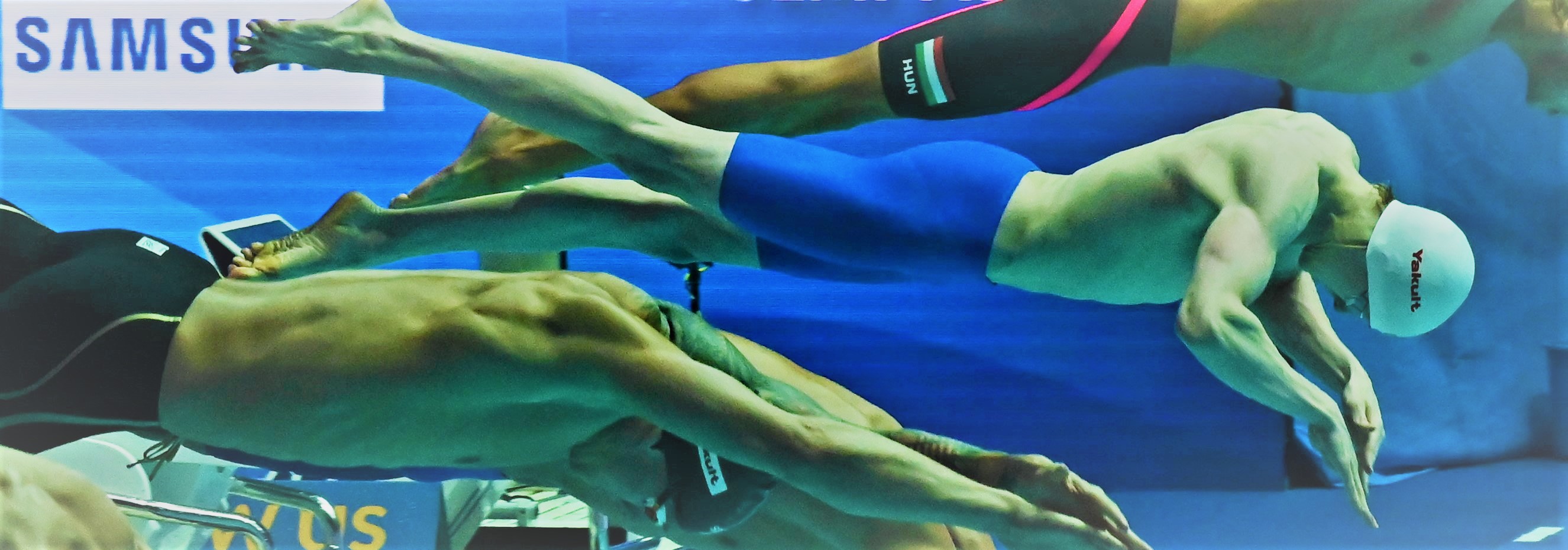
How often has a dive start been executed with a competitor, even in one of the centre lanes of the pool, loosing a meter or even a complete body length to the other competitors in their heat.
In our Technical section mywaterworld.life now has a new page exclusively dealing with with starting technique – The Art of the Start.
The Art of the Start page features a brief discussion about starting technique and two “instructional” videos – one explaining and demonstrating an advanced starting technique – the “leg kick start” – while the second provides a detailed breakdown of the complete start. Featured in the videos are coaches Bill Sweetenham and Gary Hall Snr.
By subscribing you can receive notifications of new content on mywaterworld.life as soon as it is published.
mywaterworld.life today commences a series of news stories on the results of recently conducted masters Swimming Australia State championships, highlights individual achievements and examines the overall standard of competition at those meets.
Our retrospective starts with the 37th Tasmanian Masters Swimming Championships, held on March 20 & 21 at the Doone Kennedy Hobart Aquatic Centre in Tasmania.
Highlights of the championships include the three FINA world records, the top swim by a Tasmanian at the met – Diane Perndt, Tasmanian Swimmers of the Meet – Brent Walker and Christine Brown, and Australian, and Tasmanian, South Australian and Victorian record breakers.
You can see the story direct from here or on our News web page or you can just download it.


 mywaterworld.life